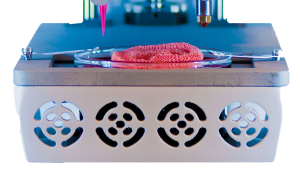
Today, with the use of 3D bioprinting technology, the construction of various tissue models such as bone, nerves, heart, and more has become increasingly achievable. One of the most challenging models has always been the creation of vessel-like structures. In conventional vascular tissue engineering methods, there is limited control over the geometry of blood vessels, and the structures created are usually within the range of large vessels. Recently, with the help of 3D bioprinting technology and coaxial nozzles, a novel and innovative solution has been introduced to address this challenge. Omidafarinan Mohandesi Ayandeh has made the printing of these structures possible by providing coaxial nozzles.

categories

In this section, you can read the full description of the product, its features, and key benefits to become familiar with the product’s function and true value.

Today, with the use of 3D bioprinting technology, the construction of various tissue models such as bone, nerves, heart, and more has become increasingly achievable. One of the most challenging models has always been the creation of vessel-like structures. In conventional vascular tissue engineering methods, there is limited control over the geometry of blood vessels, and the structures created are usually within the range of large vessels. Recently, with the help of 3D bioprinting technology and coaxial nozzles, a novel and innovative solution has been introduced to address this challenge. Omidafarinan Mohandesi Ayandeh has made the printing of these structures possible by providing coaxial nozzles.

technichal informations:

Nozzle Name Outer Needle Inner Needle Nominal Thickness
Coax1620 16G (1.19 mm) 20G (0.91 mm) 0.14 mm
Coax1420 14G (1.6 mm) 20G (0.91 mm) 0.69 mm
Coax1418 14G (1.6 mm) 18G (1.27 mm) 0.33 mm
Coax1822 18G (0.84 mm) 22G (0.72 mm) 0.12 mm

For more information, please contact the company or complete the contact form .

Further suggestions

Related products

Coaxial®

Today, with the use of 3D bioprinting technology, the construction of various tissue models such as bone, nerves, heart, and more has become increasingly achievable. One of the most challenging models has always been the creation of vessel-like structures. In conventional vascular tissue engineering methods, there is limited control over the geometry of blood vessels, and the structures created are usually within the range of large vessels. Recently, with the help of 3D bioprinting technology and coaxial nozzles, a novel and innovative solution has been introduced to address this challenge. Omidafarinan Mohandesi Ayandeh has made the printing of these structures possible by providing coaxial nozzles.

categories