


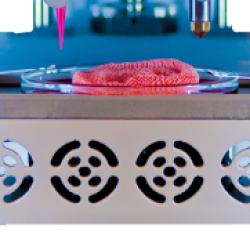
Electrospinning is one of the oldest and most widely used methods in tissue engineering, enabling researchers to produce nanofibers with very small diameters. However, limited precision in microfiber placement and inherent constraints in fabricating true three-dimensional tissues have led to reduced emphasis on this technique in modern tissue engineering.By using the Melt Electrowriting module, the advantages of electrospinning and bioprinting can be integrated within a single system. This approach compensates for the limitations of conventional electrospinning and enables the bioprinter to fabricate extremely fine and highly precise tissue structures. The use of Omid Afarinan’s high-temperature module alongside this module is recommended.
categories Modules (Printheads)
In this section, you can read the full description of the product, its features, and key benefits to become familiar with the product’s function and true value.
Electrospinning is one of the oldest and most widely used techniques in tissue engineering, enabling researchers to produce nanofibers with very small diameters. However, limited control over microfiber placement and inherent constraints in fabricating true three-dimensional tissues have reduced its prominence in modern tissue engineering.By using the Melt Electrowriting module, the advantages of electrospinning and bioprinting can be combined within a single system. This integration compensates for the limitations of conventional electrospinning and enables the bioprinter to fabricate highly delicate and precisely structured tissues. The use of Omid Afarinan’s high-temperature module in conjunction with this module is recommended.
- Capability to generate a voltage difference of up to 15 kV
- ompatible with nozzles ranging from 0.1 mm to 1 mm
- Pressure supply up to 8 bar
For more information, please contact the company or complete the contact form .
Further suggestions
Related products
Electrospinning module
Electrospinning is one of the oldest and most widely used methods in tissue engineering, enabling researchers to produce nanofibers with very small diameters. However, limited precision in microfiber placement and inherent constraints in fabricating true three-dimensional tissues have led to reduced emphasis on this technique in modern tissue engineering.By using the Melt Electrowriting module, the advantages of electrospinning and bioprinting can be integrated within a single system. This approach compensates for the limitations of conventional electrospinning and enables the bioprinter to fabricate extremely fine and highly precise tissue structures. The use of Omid Afarinan’s high-temperature module alongside this module is recommended.