

Research & Development
R&D Laboratory
The Research and Development Laboratory of Omidafarinan: A Pioneer in Biomedical Innovations and Bioprinting
Knowledge-based development in tissue engineering and bioprinting
The Research and Development (R&D) division of OmidAfarinan operates at the forefront of advanced technology development in the fields of tissue engineering and 3D bioprinting, driven by a scientific and innovative approach. Leveraging the expertise of a multidisciplinary team of researchers, biomedical engineers, and biomaterials specialists, this division focuses on the design and production of biocompatible implants and the development of three-dimensional tissue models with broad applications in regenerative medicine, drug discovery, and personalized healthcare. To this end, the company utilizes cutting-edge technologies to advance high-performance biomaterials and optimize bioprinting processes, ensuring the delivery of high-quality and efficient products.
By prioritizing the development of complex tissue models, the use of novel biomaterials, and collaboration with research centers and academic institutions, this division plays a vital role in advancing life sciences and improving public health. A steadfast commitment to continuous research, innovation, and quality serves as the foundation of this unit, making it a key pillar in realizing the company’s long-term strategic goals.

Cartilage Tissue for Repairing Articular Joint Surfaces
The R&D team at OmidAfarinan is actively researching and developing an advanced cartilage substitute with significant structural and functional similarity to native cartilage tissue. Their bold design involves the fabrication of a biodegradable 3D scaffold, layered with a hydrogel-based internal filler. The scaffold provides mechanical strength and structural support, while the highly porous hydrogel core facilitates cell growth and tissue nourishment. These two components can be fabricated from materials with different degradation rates—where the scaffold degrades more slowly to maintain mechanical load-bearing capacity, and the filler degrades faster to allow new tissue to integrate and replace it. This bioengineered construct, with customizable porosity, dimensions, and material composition, enables precise functional replication of cartilage. The innovative approach combines biomechanical stability, compatibility with native cartilage tissue requirements, and promotion of natural cell proliferation, offering a promising clinical solution for the treatment of cartilage injuries.
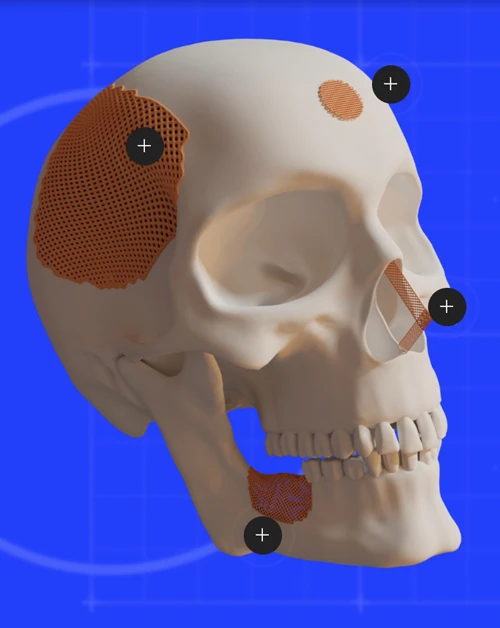
Patient-Specific Resorbable Implants for Craniofacial Bone Reconstruction
The Research and Development division of Omidafarinan Baft Ayandeh has successfully developed Iran’s first personalized, resorbable implants for the reconstruction of the jaw, face, and skull. These implants have received official approval from the Ministry of Health for clinical use. Utilizing advanced 3D printing technology and designs based on medical imaging data, the implants are tailored precisely to match each patient’s unique anatomy. Made from biocompatible materials approved by international standards such as the FDA and USP, these implants offer optimal mechanical properties and biodegradability, significantly reducing the need for secondary surgeries and accelerating the healing process. Furthermore, the application of this technology helps decrease surgical time and costs, while improving clinical outcomes in craniofacial bone defect reconstruction.
For more information about ASBone product and to explore its features and applications, please visit the page below:
Bioprinting of Artificial Cornea
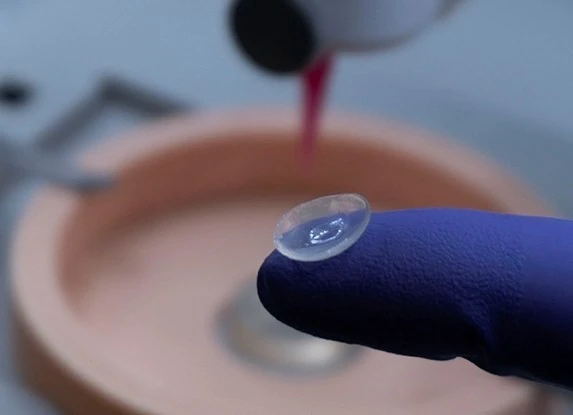
The research and development team at Omid Afarinan Company, focusing on bioprinting of ocular tissues, has launched an innovative project in the field of 3D-printed corneas. This project, conducted in collaboration with the Vice-Presidency for Science and Technology, the Nanotechnology Development Headquarters, Iran University of Medical Sciences, and Rasoul Akram Hospital, has successfully produced prototype artificial corneas using proprietary bio-inks and precision printing technology. These prototypes exhibit structural and biological properties similar to those of natural corneas. Among the unique outcomes of this research project are the development of a transparent bio-ink capable of printing complex structures, the creation of a cornea-like tissue model, and the achievement of suture compatibility. After undergoing design and optimization by the R&D team, the product has entered the animal testing phase and successfully passed preclinical evaluations. This achievement represents a significant step toward treating patients with corneal damage or defects and reducing reliance on donor transplants.