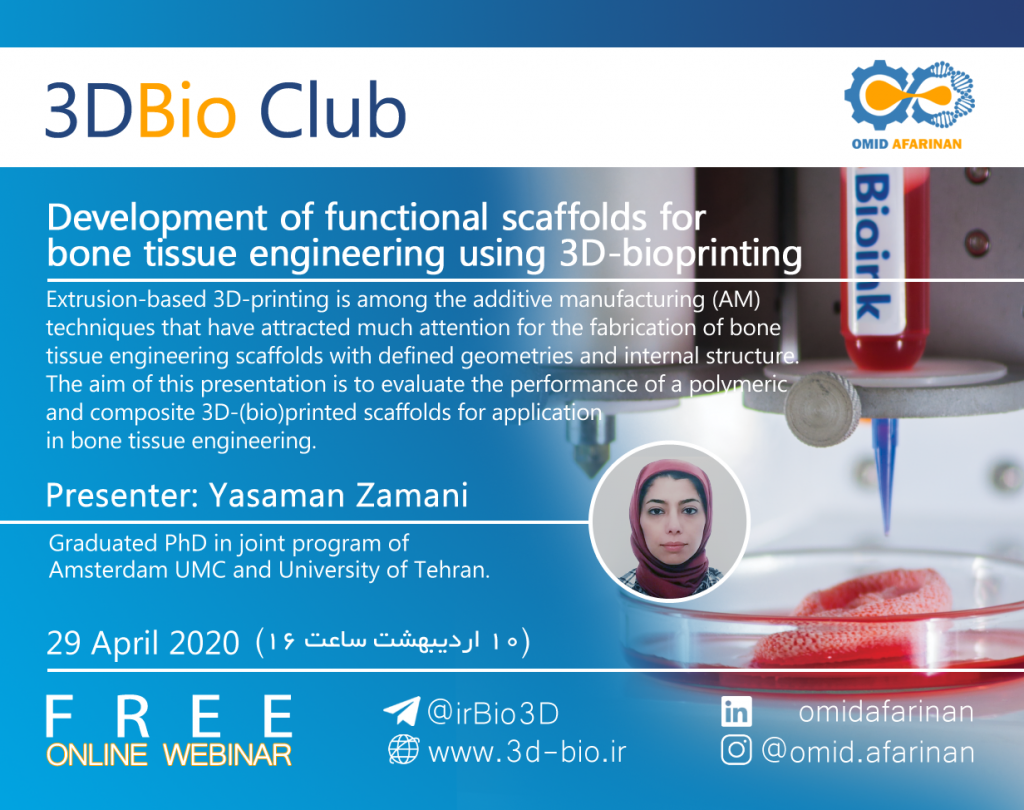
Extrusion-based 3D-printing is among the additive manufacturing (AM) techniques that have attracted much attention for the fabrication of bone tissue engineering scaffolds with defined geometries and internal structure. The aim of the studies performed in this thesis was to evaluate the performance of polymeric and composite 3D-(bio)printed scaffolds for application in bone tissue engineering.
We started by 3D-printing of polycaprolactone (PCL) scaffolds and subsequent surface modification of the PCL scaffolds either by introduction of carboxyl and hydroxyl functional groups on the surface through sodium hydroxide (NaOH) treatment, or by immobilization of arginine-glycine-aspartic acid (RGD) peptide on the surface of the scaffolds. Cell proliferation increased in the 24 h NaOH-treated scaffolds by 3-fold and in the RGD-immobilized scaffolds by 4.5-fold. 24 h NaOH-treated scaffolds increased alkaline phosphatase (ALP) activity by 5-fold, while the increase by RGD immobilization was only 2.5-fold. Only 24 h NaOH-treated scaffolds enhanced mineralization (2.0-fold) compared to unmodified controls, making it the treatment of choice to promote bone formation by osteogenic cells.
In the next step, we modified the mechanical properties of the 3D-printed PCL scaffolds based on the predicted forces on mandibular symphysis during opening and closing of the jaw. Our modeling results showed that during jaw opening, a compressive force was induced throughout the symphyseal line that reduced from top-to-bottom, while a small tensile force was induced only in the lower parts of the symphysis. Therefore, we designed gradient scaffolds with increasing void size from top-to-bottom to achieve a gradient of compressive strength in the scaffold. We also showed that the 3D-printed PCL scaffolds had higher compressive strength (~ 2-fold) in the scaffold layer-by-layer building direction compared with the side direction, which should be taken into account when designing and placing the scaffold in the defect site

:Dr. Yasamin Zamani
After finishing her MSc in Biomedical Engineering (Biomaterials), she started her PhD jointly at the Department of Oral and Maxillofacial Surgery, Amsterdam UMC, and the Department of Biomedical Engineering, University of Tehran. My research focus is on the 3D-bioprinting of bone tissue substitutes and biomaterials surface modification. Her current project is ‘Bone Tissue Engineering using 3D-(bio)printing for Maxillofacial Reconstruction’
At the conclusion, experts in this field who are interested in presenting their scientific work or articles related to 3D bioprinting are invited to get in touch with the specialists at Omid Afarinan Future Engineering Company through the provided communication channels.